Archives

  • Neonatal and Early Infant Male Circumcision with the Plastibell Device: Indications and Complications
    Vol. 1 No. 3 (2026)

    FOREWORD

    Volume 1 Number 3 goes with the title: “Neonatal and Early Infant Male Circumcision with the Plastibell Device: Indications and Complications” where researchers at Edo State University looked at Neonatal and Early Infant Male Circumcision with the Plastibell Device: Indications, Complications, and Maternal Satisfaction at a Nigerian Tertiary Hospital. The researchers were driven by the need to search for a more clinically efficient and socially acceptable method of male circumcision different from the traditional methods.

    They found that: The predominant indication for circumcision was religious (n=92, 60.5%), followed by health/medical (n=31, 20.4%) and cultural (n=29, 19.1%) reasons. Mothers with tertiary education were more likely to request circumcision for health reasons (p < 0.001, Fisher's Exact Test). The mean age at circumcision was 12.0 ± 5.0 days. The mean procedure duration was 15.5 ± 2.2 minutes. Post-procedure pain was predominantly mild (n=126, 82.9%). Complications occurred in 10 cases (6.6%): 9 (5.9%) had minor bleeding managed conservatively, and 1 (0.7%) had mild scrotal swelling that resolved spontaneously. There were no recorded infections, haematomas, open wounds, urinary retention, or procedure-related deaths. Maternal satisfaction was very high as 150 mothers (98.7%) were very satisfied and 2 (1.3%) were satisfied; none was dissatisfied. Complications did not significantly affect satisfaction (Fisher's Exact Test, p = 1.000).

    They therefore concluded that neonatal and early infant circumcision with the Plastibell device by trained medical personnel was safe and associated with a low complication rate and high

    maternal satisfaction.

    Professor Godwin T. Jombo

    Editor-In-Chief

  • Clinical features of opportunistic infections

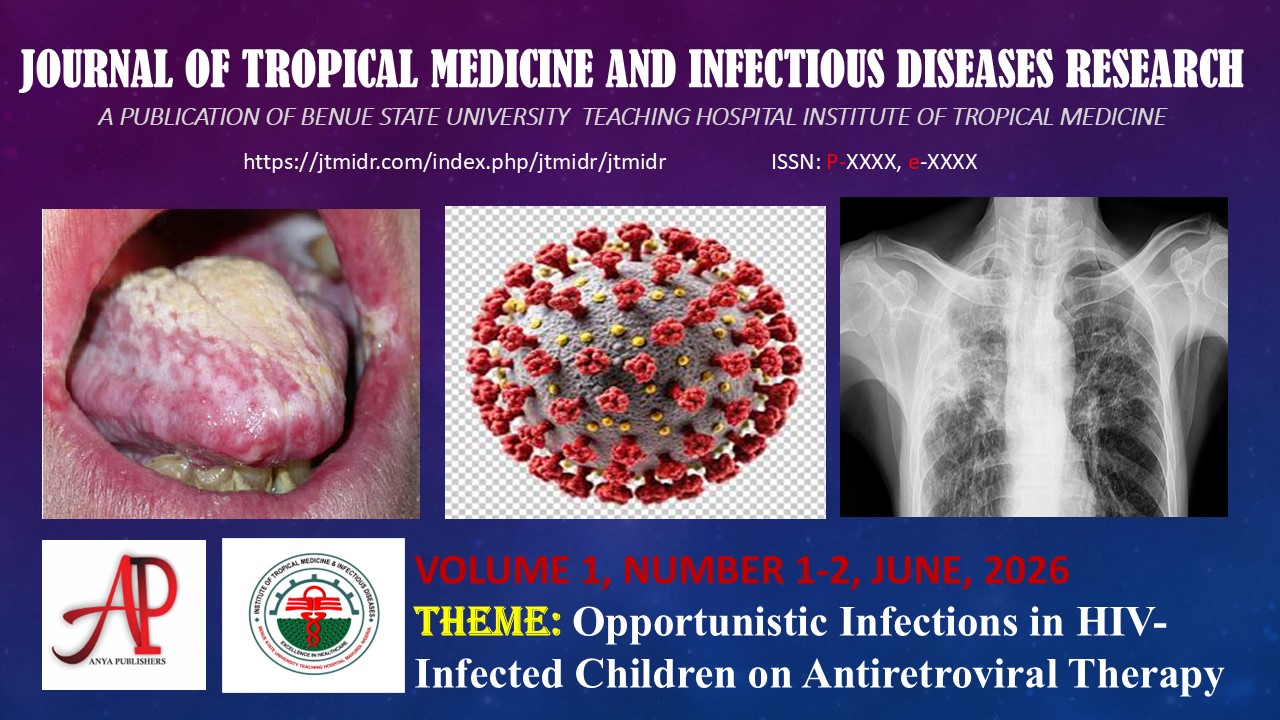
    Opportunistic Infections in HIV-Infected Children on Antiretroviral Therapy
    Vol. 1 No. 1-2 (2026)

    Foreword

    On behalf of editorial board, I welcome you to the maiden edition of the Journal of Tropical Medicine and Infectious Diseases Research (JTMIDR). This issue goes with the title: Opportunistic Infections in HIV-Infected Children on Antiretroviral Therapy. The researchers looked at prevalence, pattern, and independent risk factors for Opportunistic Infections (OIs) among Children Living With Human Immunodeficiency Virus (CLHIV) in Plateau State, Nigeria. And they found that the prevalence of any OI was 56.4% (228/404). Pulmonary tuberculosis (PTB) was the most common (31.7%, 128/404), followed by oral candidiasis (9.9%, 40/404), bacterial pneumonia (9.4%, 38/404), and sepsis (6.4%, 26/404). On multivariable analysis, female sex ((AOR = 2.70, 95% CI: 1.41–5.26, p = 0.003), orphan status (AOR = 2.82, 95% CI: 1.49–5.31, p = 0.001), duration of CPT less than two years AOR = 4.24, 95% CI:1.66–10.86, p = 0.003), and CD4 count <200 cells/μL (AOR = 5.84, 95% CI: 2.39–14.26, p < 0.001) emerged as independent predictors of OIs.

    Patterns of presentation and management outcomes of  a rapidly progressive and life-threatening necrotizing fasciitis of the perineum, genitalia, and perianal region commonly referred to as Fourrnier’s gangrene was studied by researchers at two tertiary health centres in north-central and south-south regions of Nigeria. They found that hirteen patients (all male) were managed during the study period, with a mean age of47.9 ± 12.9 years (range 28-76 years). The scrotal region was the commonest site of involvement (46.2%). Diabetes mellitus and smoking were each present in 46.2% of cases. HIV seropositivity was documented in 15.4%. All patients underwent aggressive surgical debridement (mean 4.9 ± 1.8 procedures) combined with broad-spectrum antibiotics. The predominant organisms isolated were Escherichia coli and Staphylococcus aureus (each 46.2%), with polymicrobial infection in 38.5%. Two patients (15.4%) died. HIV seropositivity was the only variable significantly associated with mortality. They therefore advised on early detection and an aggressive management of the disease.

    Professor Godwin T. Jombo

    Editor-In-Chief